
In Taoist thought, breath and qi are closely linked. The Chinese word qi originally referred to vapour or breath, and Taoist practitioners have used breathing exercises for more than two thousand years to calm the mind, strengthen the body and move energy where it is needed. Modern research on slow breathing supports some of this: slowing your breath to around six breaths a minute is known to calm the nervous system and lower stress.
Here are five Taoist breathing practices you can use for energy healing. They build on each other, so it helps to start at the top. For background, see Energy Healing Explained and our earlier guide to Taoist breathing techniques.
1. Abdominal (dantian) breathing
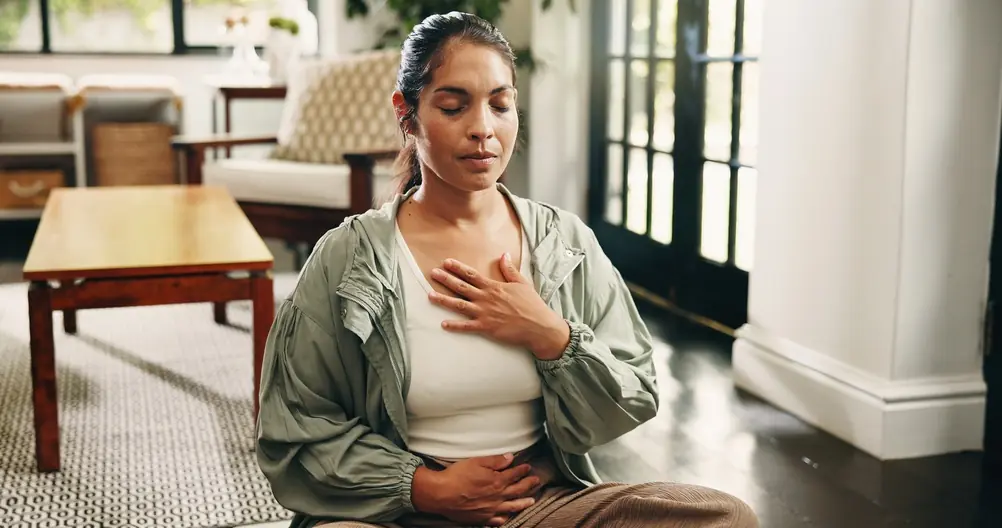
This is the foundation of every other practice. Sit with a straight but relaxed spine, place your hands just below your navel and breathe in slowly through your nose, letting the belly expand. Breathe out gently through the nose as the belly softens. Keep the chest and shoulders quiet.
Practise for five to ten minutes a day. Taoists say this gathers qi in the lower dantian, the body’s main energy centre. Most people simply notice they feel calmer and more grounded.
2. The six healing sounds
The six healing sounds (liu zi jue) pair a gentle out-breath sound with an organ. Traditional versions differ slightly, but a common set is: “sss” for the lungs, “choo” for the kidneys, “shhh” for the liver, “haw” for the heart, “hoo” for the spleen and “heee” for the triple burner (the whole torso).
Breathe in through the nose, then breathe out slowly while making the sound almost silently, imagining tension leaving that area. Do each sound three to six times. The practice is linked with emotional release in Taoist medicine; for example, the lung sound is associated with letting go of grief. See Qi and Emotional Health for how organs and emotions are connected.
3. Embryonic breathing
Embryonic breathing (tai xi) aims to make the breath so soft and slow that it is barely noticeable, like a baby in the womb. Start with abdominal breathing, then gradually let each breath become finer and quieter, as if a feather in front of your nose would not move. Do not hold your breath or strain.
This is a meditative practice rather than an exercise. Ten minutes leaves most people deeply relaxed. If you feel short of air, return to normal breathing.
4. Microcosmic orbit breathing
The microcosmic orbit is a loop of energy that Taoists describe running up the spine and down the front of the body. On the in-breath, imagine warmth rising from the base of the spine to the crown of the head. On the out-breath, let it flow down the front of the body to the navel. Keep the tongue lightly touching the roof of the mouth to “close the circuit”.
Our full guide to Microcosmic Orbit Meditation walks through each point on the loop.
5. Standing qi breath
Stand with feet shoulder-width apart, knees slightly bent and arms rounded in front of the chest as if hugging a tree. Breathe slowly into the belly. As you breathe in, imagine energy rising from the ground through your feet; as you breathe out, let it settle in the dantian.
Start with three to five minutes and build up. This standing practice, known as zhan zhuang, is a core part of qigong and builds strength and rootedness. Our Taoist qigong for beginners guide has more standing and moving exercises.
Tips for practising safely
- Never force or hold the breath. Taoist breathing should always feel comfortable.
- Practise on an empty or light stomach, ideally at the same time each day.
- If you feel dizzy, stop and breathe normally.
- If you have a heart or lung condition, are pregnant or have a history of panic attacks, check with your doctor before starting deeper practices.
- Breathwork supports wellbeing but is not a substitute for medical treatment.
Frequently Asked Questions
How long before I notice benefits from Taoist breathwork?
Most people feel calmer after a single session of abdominal breathing. Deeper changes in energy and sleep usually take a few weeks of daily practice.
Which Taoist breathing practice is best for stress?
Abdominal breathing and the six healing sounds are the most useful for stress, as they slow the breath and encourage emotional release.
Can breathwork help with energy healing on its own?
Breath is central to Taoist energy work and can be practised on its own. Many people combine it with qigong, meditation or tai chi.
Should I breathe through my nose or mouth?
In most Taoist practices you breathe in and out through the nose. The six healing sounds are the main exception, as the sounds are made on the out-breath through the mouth.
Leave a Reply