
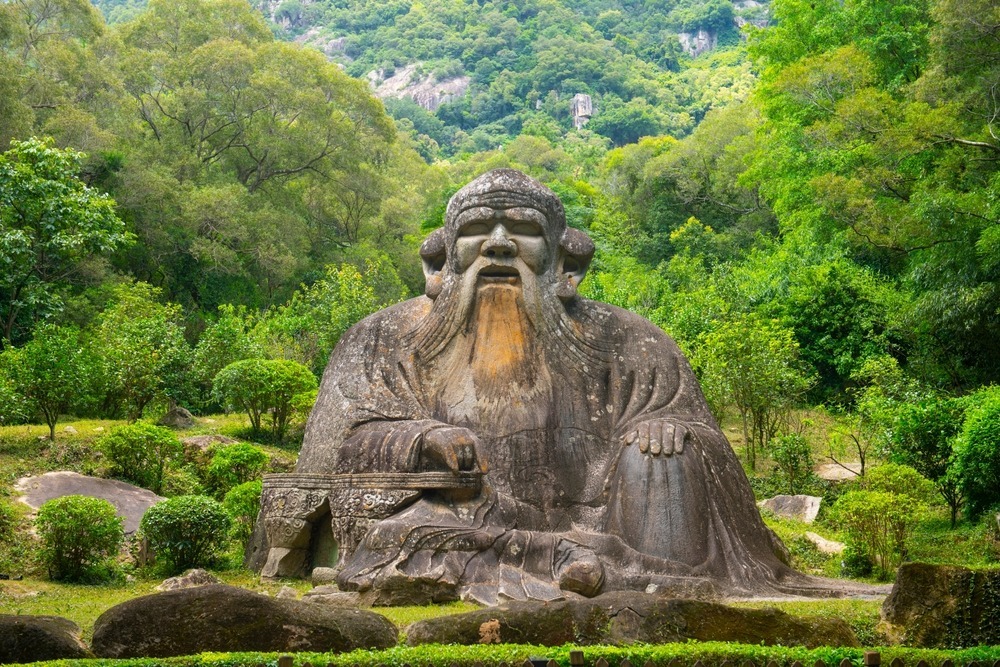
Introduction to the Taoist Way
Man is generally a social being who more often than not, would find a sense of purpose from his or her relationship with others and with the higher being. It is said that the purpose for which you do something will largely determine just how you do it. This principle applies to life itself – the purpose and belief by which you live will determine the quality of life that you experience. Taoism offers a “path” in life, providing both purpose and guiding principles for believers. Below is a summary of the fundamental principles that form the foundation of Taoist philosophy.
Tao: The Universal Way
Analysts have noted that Tao promotes principles consistent with natural laws. This observation aligns perfectly with Taoist thought. After all, the Tao principles describe the essential way that every person needs to follow. This principle attempts to answer questions about the fundamental force behind the universe – explaining what is and what is not. According to this principle, energy (qi) and its flow direction determine the state of being for both the universe and the individual. If you seek peace in your life, applying this principle of Taoism becomes essential.
The Tao represents the underlying pattern and substance of the universe – a force that cannot be fully grasped by intellect alone but must be experienced through intuitive wisdom. It flows through all things, connecting them in a vast web of interdependence. Understanding the Tao means recognising that all opposites are complementary aspects of a greater whole.
De or Te: The Way Through Virtue
This principle stipulates how to activate the Tao principle in daily life. It emphasises the need to tap into Taoism’s power through humility and integrity. As a way of life, De teaches that actively pursuing the Tao principle is the only way to realise its power. By cultivating virtuous qualities that align with nature’s patterns, one develops the ability to live in harmony with the Tao.
De represents the manifestation of Tao in the individual – the personal expression of cosmic harmony. Through cultivating simplicity, compassion, and moderation, practitioners develop a character that naturally aligns with universal principles. This virtue arises not from forced morality but from alignment with one’s true nature.
Wu Wei: Effortless Action
Translated directly, Wu Wei refers to “effortless doing.” This means that as a Taoism believer, one need not force things to go their way. This differs significantly from most principles applied in Western thought. Compared to principles such as capitalism – which may encourage taking advantage of others and using all available means to achieve goals – a Taoist is not expected to fight to make things work according to personal desire. Instead, one surrenders to the higher powers that ultimately control human events. This ability to surrender to the universe’s power leads to a deep sense of peace.
Wu Wei does not mean doing nothing, but rather acting without strain or struggle – moving with the natural current rather than against it. By understanding the inherent patterns in situations, one can accomplish much with minimal effort. The sage achieves great things by allowing them to unfold naturally rather than through force or manipulation.
P’u: Embracing Simplicity
This principle of Taoism emphasises the need for simplicity and inner peace. P’u, translated as “uncarved block,” stresses the importance of maintaining pure perception of events. A Taoist accepts nature’s control without attempting to impose artificial meanings beyond what is visible. A believer surrenders to and accepts the outcomes determined by natural forces. Therefore, to such a practitioner, there is never anything really “beautiful” or “ugly” – everything simply is, and in that existence, everything possesses its own form of beauty.
P’u represents a return to our original nature – uncomplicated, receptive, and without prejudice. Like an uncarved block of wood that contains infinite potential, the mind that maintains simplicity can adapt to any situation. By clearing away preconceptions and judgements, we see reality more clearly and respond to it more effectively.
The Integrated Taoist Life
These principles work together to create a holistic approach to living. By understanding the Tao, cultivating Te, practising Wu Wei, and embracing P’u, practitioners develop a balanced relationship with themselves, others, and the natural world. This integration leads to a life of reduced struggle, increased harmony, and deeper satisfaction – not through acquiring more, but through aligning with the natural order of existence.
The Taoist path offers an alternative to the striving and conflict that characterise much of modern life. By following these principles, one discovers that true fulfilment comes not from imposing one’s will upon the world, but from finding one’s place within it.
Search the website
Blog Categories
- Chakra Healing (6)
- Energy Cultivation (2)
- Energy Healing (8)
- Guest Posts (16)
- Meditation & Mindfulness (1)
- Personal Growth (17)
- Relationships (2)
- Sexual Wellness (3)
- Spiritual Growth (5)
- Spiritual Psychology (3)
- Spiritual Wellness (3)
- Spirituality (9)
- Tantra & Sacred Sexuality (5)
- Tao Lifestyle (3)
- Taoism & Chinese Philosophy (4)
- Taoist And Buddhist Contacts (1)
- Taoist Philosophy (4)
- Taoist Practices (3)