
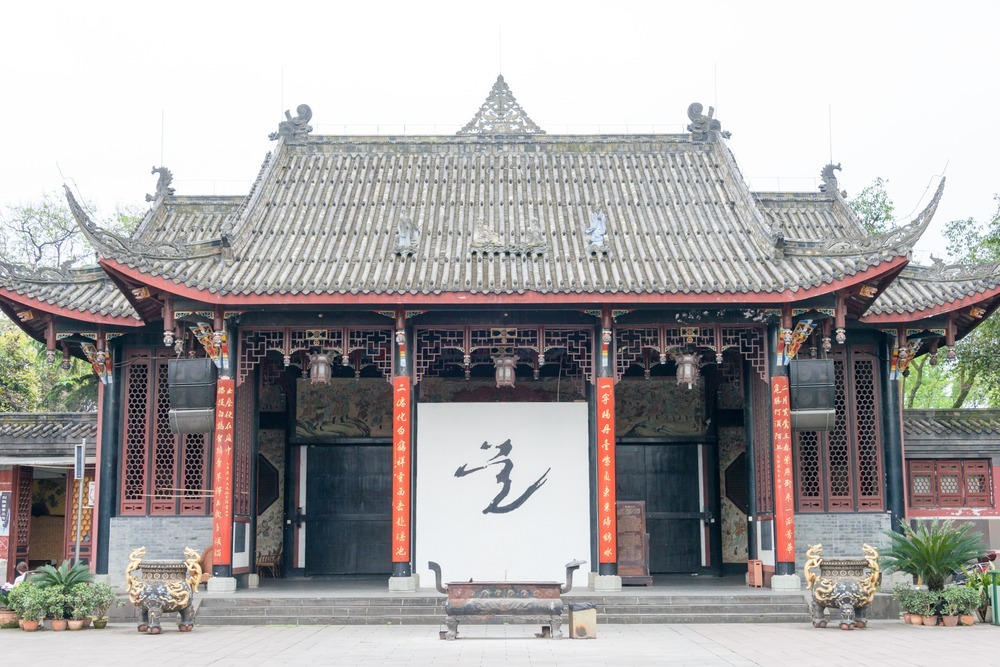
The Holy Place
Qingcheng Shan stands as a holy Taoist mountain, an early home to Taoism and its teachings dating back to approximately 100 AD. For any student or believer in Taoism, visiting this sacred site becomes both a revelation and catalyst for deeper understanding. After the public bus ride from Chengdu, visitors enter a naturally serene and tranquil setting adjacent to the vast and extremely fertile Chengdu Plain and the UNESCO World Heritage listed Dujiangyan Irrigation Project, which still services around one million acres of farmland.
Natural Harmony
The Qingcheng Shan Taoist temples nestle amongst towering cypress pine, plum, and ginkgo trees, dramatic escarpments, sweeping ridges, and cascading streams. This area is naturally blessed with reliable rainfall, fertile soils, and an ambient climate – likely temperate in nature and conducive to sustained lush vegetation growth, earning the mountain its name: “green place.”
Three Essential Words
The mountain impresses visitors with its deep sense of tranquillity, inspiring three fundamental Taoist concepts: Abundance, Sustenance, and Harmony. These words represent a place at one with nature, embodying balance and stability. Although a major earthquake in 2008 virtually destroyed many of the mountain’s ancient structures, its spiritual essence remains intact.
Walking in Ancient Footsteps
Pilgrims come to see firsthand what ancient Taoists witnessed in this world about one thousand years before. They too would have embraced nature’s willingness to envelop them and sustain them in its simplicity. Those early Taoists didn’t seek to impose themselves on the world but instead remained within its bounds – this forms the core of true Taoist beliefs and the principle of acceptance. They respected nature in this place because it provided what they needed without excessive effort or need for change.
Beyond Western Misunderstanding
Walking up many steps and meditating upon a perched lake, some modern visitors with Western logic might mistakenly think, “They were lazy people.” This perspective shows disrespect by making broad assumptions about people who began inhabiting these mountains two thousand years ago. Perhaps the forest itself was writing those ancient Taoist principles, and the practitioners simply accepted and tolerated rather than seeking to build change – which would have required different energies than those they chose to follow.
If the season was abundant, they flourished; if not, they suffered alongside the animals and plants of the world, accepting nature’s cycles. The Mountain possessed a special energy and could provide what the Taoists sought. Nature was there to do their bidding, and they were grateful recipients.
The Middle Way
To modern observers, the Taoists might seem unwilling to touch, transform, or take from nature. While contemporary society might label them extremists, here they simply follow the “middle way.” Perhaps this concept emerged from the necessity to survive within natural boundaries while transferring knowledge to create something more sustainable, such as the cultivation of rice and fruit trees.
The Flow of Qi
Great symbolism exists in the trees, their trunks and shapes, the mountain slopes, and the movement of water flowing through the world. The Qi (Chi energy) flows from the mountain peaks and slopes to the plains, while water from the mountains provides life force as essential as the air we breathe. The Feng Shui of the mountain relies on its gentle folding into the Chengdu plain. The mountain’s Qi manifests in its clean, oxygen-charged air and in the freshness and purity of water flowing from springs within.
Three Words of Wisdom
The three words – abundance, sustenance, and harmony – aptly express the essence of Taoist thought for such a sacred place. They encapsulate the philosophy’s core principles of living in balance with nature.
Experiencing the Sacred Mountain
Visitors should prepare for numerous steps, bring comfortable walking shoes, allow plenty of time, and consider taking the cable car to a viewing platform. One may notice how the Yin and Yang of the area remain in balance through the shapes and colours of all things. The mountain’s Qi descends upon visitors as they become immersed within the confines of the space, evident in the health and vibrancy of the worlds and the movement of living things (including the trees). This place invites testing of the eight elements: light, shadow, shapes, colours, sounds, smell, movement, and temperature – noticing their presence and how they balance in their individual Yin and Yang. One becomes aware of how they harmonise with each other to form a cohesive unit of perfect balance.
The Essence of Taoism
More a philosophy than a religion, Taoism concerns itself with finding equilibrium between how we live our lives and the demands life places upon us. Translated literally as “The Way,” following the Tao means practising a form of minimal action called “wu wei.” Taoism describes this as the practice of going against the stream not by struggling against it and thrashing about, but by standing still and letting the stream do the work. Thus, the sage knows that relative to the river, they still move against the current.
The Sage’s Wisdom
To outside observers, the sage appears to take no action, but in fact, they take action long before others foresee the need for action. In other words, Taoism represents a form of passive resistance – making sure preparation for every eventuality and flowing with circumstances as they unfold, finding the path of least resistance while maintaining one’s essential purpose.
Ancient Sanctuary of Taoist Wisdom
A Sacred Heritage in Chengdu
Situated in the northwestern suburbs of Chengdu, the Qingyang Gong (Bronze Goat Taoist Temple) stands as one of the oldest and most revered Taoist temples in the Chengdu region. For anyone with an interest in Taoist culture, this temple represents an essential destination – easily accessible and offering visitors a magnificent show of traditional architecture and detailed sculptures that embody Taoist principles and aesthetics.
Historical Evolution
During the flourishing period of Taoism in China, the temple was originally established in the Tang Dynasty (618-907 CE). However, most structures visible today were added during extensive restorations carried out during the Qing Dynasty (1644-1911). The temple’s name has an intriguing historical connection – Emperor Xizong of the Tang Dynasty reportedly sought refuge here while escaping from Chang’an (modern Xi’an). In gratitude for the sanctuary provided, he renamed the temple from its original “Xuanzhong Taoist Temple” to “Qingyang Gong.”
Architectural Treasures
The Qing Dynasty restorations enriched the temple complex with several significant structures that still stand today:
- Sanqing Hall (Three Pure Ones Hall)
- Hunyuan Palace (Primordial Palace)
- Doulao Hall (Hall of the Dipper Stars)
- Lingzu Hall (Ancestral Hall)
- Wuji Palace (Palace of Infinite Void)
- Eight Trigrams Pavilion
Among these architectural wonders, the Eight Trigrams Pavilion particularly captivates visitors with its extraordinary majesty and lively spiritual presence. This structure brilliantly represents the ancient Chinese philosophical concept that “the earth is square and the sky is round” – featuring a square foundation symbolising earth, topped with a roof of colourful glazed round tiles representing heaven. Eight imposing pillars support the pavilion, each adorned with detailed dragon carvings in relief.
Sacred Artefacts
Inside the Sanqing Hall stand two remarkable bronze goats beside the altar. These are no ordinary representations – they feature fascinating composite elements from various animals, creating mythologically significant beings. According to temple lore, these bronze sculptures were transported from Beijing, adding to their historical and cultural significance.
Other notable cultural relics include the stone sculpture of Patriarch Lü Dongbin (one of the Eight Immortals in Taoist tradition) and preserved abstracts from collected Taoist scriptures that offer insights into the philosophical depth of Taoist teachings.
Living Tradition
The temple continues to function as a living centre of Taoist practice and culture. Visitors particularly interested in experiencing Taoist celebrations might plan their visit to coincide with the annual fair held on the fifteenth day of the second lunar month. This festival takes place in the cultural park adjacent to the temple and celebrates the birthday of Laozi (Lao Tzu), the revered founder of Taoism.
A Gateway to Taoist Understanding
For travellers seeking to understand the deep relationship between Taoist philosophy and Chinese cultural heritage, Qingyang Temple offers an authentic glimpse into this ancient spiritual tradition. The temple’s serene courtyards, symbolic architecture, and carefully preserved artefacts create an atmosphere where visitors can connect. Experience the core Taoist principles of harmony with nature, balance between opposing forces, and the pursuit of simplicity amidst complexity.